
For any modern fleet, safety and efficiency are top priorities. A key part of this is following federal rules, especially the Electronic Logging Device (ELD) Mandate. This important regulation replaced traditional paper logbooks with reliable electronic devices. The goal is to create safer roads by accurately tracking driver hours and preventing fatigue.
Achieving ELD compliance involves more than just installing new hardware. It requires a clear understanding of the rules and a commitment to using the technology correctly. This guide is designed to help. We will walk you through the key parts of the ELD Mandate, explain the newest Hours of Service (HOS) rules, and offer best practices to keep your fleet fully compliant.
What is the ELD Mandate? A Foundation for Safety
The ELD Mandate is a federal regulation enforced by the Federal Motor Carrier Safety Administration (FMCSA). Its primary goal is to improve road safety by ensuring that commercial motor vehicle (CMV) drivers adhere strictly to the established Hours of Service (HOS) rules.
Before the mandate, drivers used paper logs to manually record their on-duty and off-duty time. This system was prone to human error and deliberate falsification. The mandate requires most CMV operators to use a registered Electronic Logging Device. An ELD synchronizes directly with a vehicle’s engine to automatically record driving time, providing an accurate and verifiable account of a driver’s activity. This automation creates a safer environment for all road users.
Who is Required to Maintain ELD Compliance?
The mandate applies to the vast majority of commercial drivers who are required to maintain Records of Duty Status (RODS). However, the FMCSA has outlined a few specific exemptions, which were updated in 2020. Your fleet is likely exempt only if your drivers fall into one of these categories:
- Short-Haul Drivers: Drivers operating within a 150 air-mile radius of their primary work reporting location and finishing their work within a 14-hour shift.
- Driveaway-Towaway Operations: Operations where the vehicle being driven is the commodity being delivered.
- Pre-2000 Vehicles: Vehicles with an engine model year of 1999 or older.
For all other operations, ELD compliance is a strict requirement. Failure to comply can result in significant fines, out-of-service orders, and a negative impact on your company’s safety rating.
Understanding the Core: The Updated Hours of Service (HOS) Rules
The ELD’s primary function is to track Hours of Service. On September 29, 2020, new FMCSA revisions to the HOS rules went into effect, providing more flexibility for drivers. Understanding these updated rules is essential.
The following table summarizes the key HOS limits for property-carrying drivers under the current regulations:
| Rule Name | Time Limit | Description |
| 14-Hour “Driving Window” | 14 consecutive hours | After coming on duty, a driver has a 14-hour window to complete all driving. This window does not stop for breaks. Once the 14 hours are over, the driver cannot drive again until completing a 10-hour off-duty period. |
| 11-Hour Driving Limit | 11 total hours | Within the 14-hour window, a driver is only permitted to drive for a cumulative total of 11 hours. |
| 30-Minute Driving Break | 30 consecutive minutes | A driver must take a 30-minute break after 8 cumulative hours of driving time. An on-duty, non-driving period (like fueling or waiting for cargo) now qualifies for this break. |
| 60/70-Hour Limit | 60 hours / 7 days or 70 hours / 8 days | A driver cannot be on duty for more than 60 hours in any 7-consecutive-day period, or 70 hours in any 8-consecutive-day period. This is reset after a driver takes at least 34 consecutive hours off duty. |
In addition to these core rules, the 2020 revisions introduced more flexibility through two key exceptions:
- Adverse Driving Conditions Exception: This allows drivers to extend the 14-hour driving window by up to two additional hours if they encounter unforeseen adverse driving conditions, such as a sudden snowstorm or a major traffic accident.
- Sleeper Berth Provision: This gives drivers more flexibility in splitting their required 10-hour off-duty period. Drivers can now use a split-sleeper option, such as a 7/3 split or an 8/2 split (either in or out of the berth), as long as the two periods total 10 hours. When used this way, neither period counts against the 14-hour driving window.
Technical Requirements of a Compliant ELD
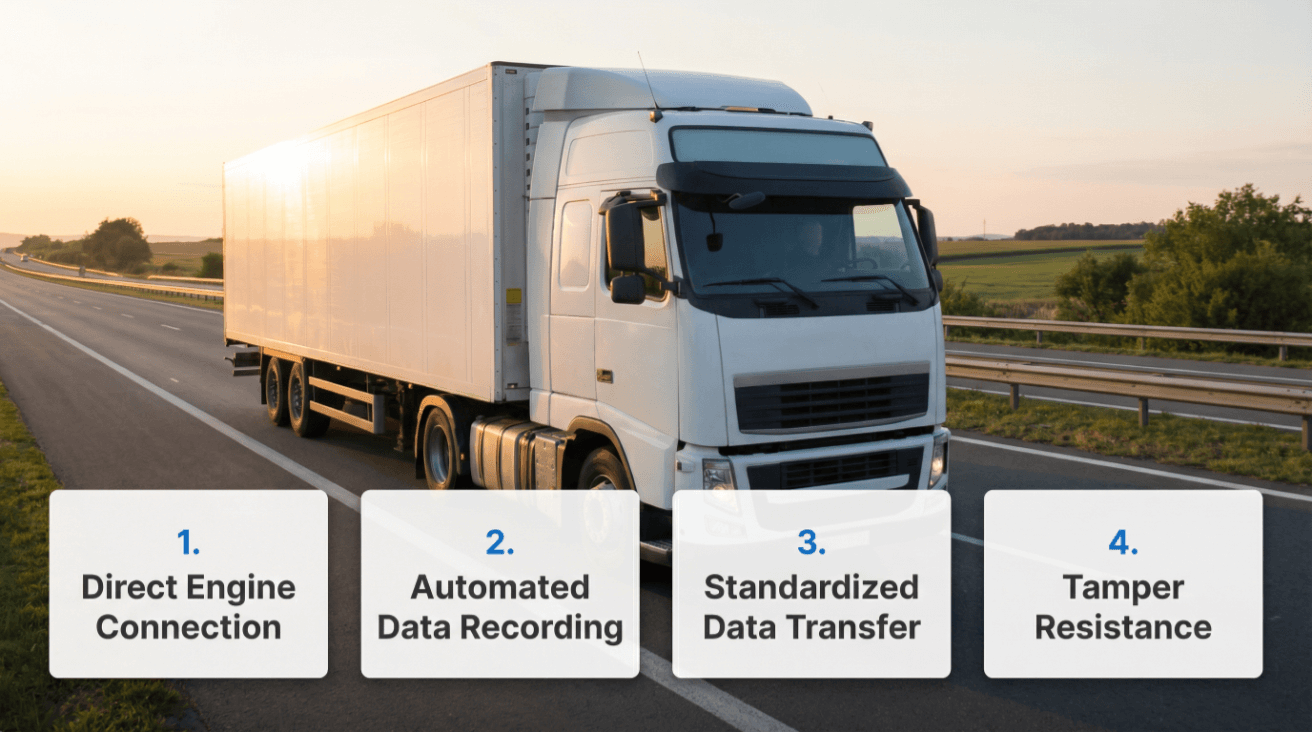
Not all electronic logging systems qualify as a compliant ELD. To be registered with the FMCSA, a device must meet specific technical standards. When selecting a solution, ensure it has the following capabilities:
- Direct Engine Connection: The device must connect directly to the vehicle’s Engine Control Module (ECM) via the diagnostic port (e.g., J1939, J1587, or OBD-II). This is essential for automatically capturing engine status, motion, and hours.
- Automated Data Recording: The ELD must automatically record the date, time, location, engine hours, and driver identification. Location must be recorded at 60-minute intervals when the vehicle is in motion.
- Standardized Data Transfer: During a roadside inspection, the device must be able to present a standardized data file to law enforcement via a wireless web service or a local USB/Bluetooth connection.
- Tamper Resistance: The system must be designed to prevent unauthorized alteration or erasure of the raw data it collects.
Choosing the Right Hardware for Flawless Compliance
The reliability of your ELD compliance program begins with the quality of your hardware. A device that is difficult to install or frequently loses connection can cause significant problems.
The KD032 is an Electronic Logging Device engineered for reliability and ease of use. It is a plug-and-play device that connects directly to the vehicle’s diagnostic port, simplifying installation and reducing downtime. By supporting universal protocols like J1939, it ensures seamless communication with the engines of most North American heavy-duty trucks. The KD032 not only ensures accurate data capture for ELD compliance but can also serve as a power hub for other peripherals, such as dashcams, streamlining the technology within the cab.
Best Practices for Maintaining a Culture of Compliance
Implementing an ELD system is an ongoing process that requires commitment from the entire organization.
- Comprehensive Driver Training: Ensure every driver is fully trained on how to use the ELD, including changing duty statuses, understanding the new break and sleeper berth options, and transferring data during an inspection.
- Regular Log Audits: Fleet managers must regularly review driver logs. Look for unassigned driving records and other potential discrepancies to correct bad habits before they lead to violations.
- Proper Device Management: Keep a supply of spare devices and instruction manuals in case of a malfunction. Drivers must know the procedure for switching to paper logs if their device fails.
- Maintain Supporting Documents: The ELD does not eliminate the need for supporting documents. You must still retain records such as bills of lading and dispatch records to verify logbook accuracy.
Compliance as a Competitive Advantage
ELD compliance is a smart business decision that goes beyond simply following the law. Using this technology correctly helps you prevent accidents caused by tired drivers, which can lead to lower insurance costs and a smoother operation. The path to success is clear: understand the rules, build a team that prioritizes safety, and choose dependable hardware for the job. A solid compliance plan protects what matters most—your drivers, your vehicles, and your company’s reputation. It’s how you turn a federal rule into a real benefit for your business.


